
Injection Mold Quality Control Through Integrated Process Management
In custom injection mold manufacturing, quality problems should not wait until the final QC stage to be discovered. By that time, the cost of correction is already higher, the delivery schedule may be affected, and the customer’s project risk increases.
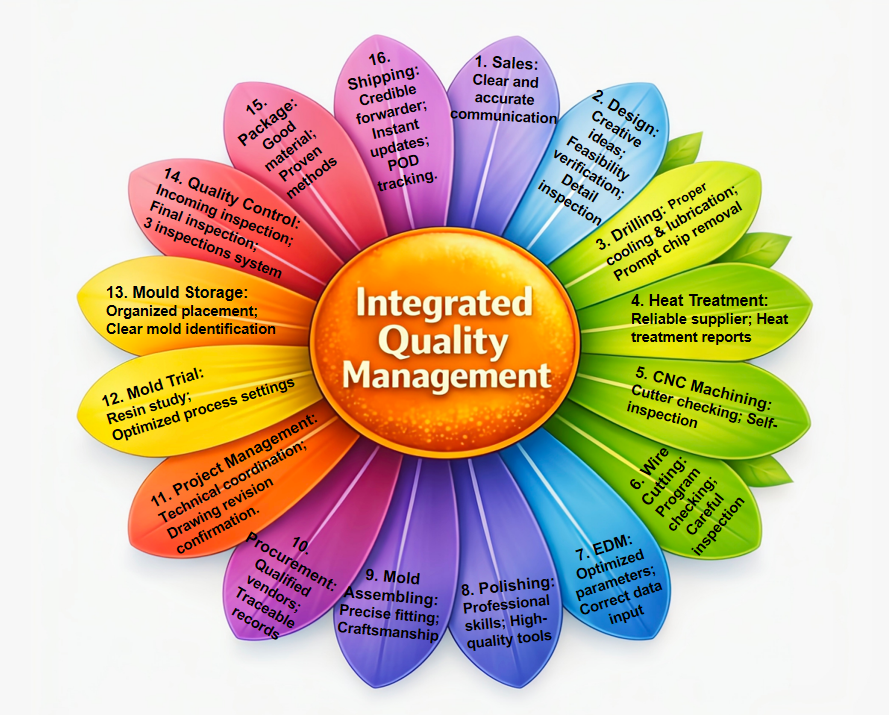
At WIT MOLD, quality is not treated as the responsibility of one department only. Sales, engineering, machining, procurement, assembly, project management, trial molding, packing, and shipping teams all play a role in building a reliable mold.
This is why WIT MOLD follows an integrated quality management mindset: inspection can find problems, but process control helps prevent them.
Why Final Inspection Alone Is Not Enough
Final inspection is important, but it is not enough to guarantee long-term mold performance. A plastic injection mold is a complex production tool. Its quality depends on design decisions, steel selection, machining accuracy, fitting work, cooling layout, polishing quality, mold trial settings, and many other details.
If an issue appears at the final inspection stage, it usually means the problem was already created earlier in the process.
For example:
- Poor design communication may lead to wrong tooling direction.
- Inaccurate machining may cause fitting problems.
- Uncontrolled heat treatment may affect steel stability.
- Poor polishing may influence part appearance.
- Incorrect trial settings may hide potential molding risks.
- Weak packaging may damage the mold during shipment.
For international buyers, these risks can become serious after the mold arrives at their factory. That is why process-based quality control is essential for custom plastic injection molds, high precision molds, automotive molds, medical molds, two-shot molds, unscrewing molds, insert molding tools, and high cavitation molds.
WIT MOLD’s Integrated Quality Management Process
WIT MOLD controls quality through multiple project stages. Each step has its own responsibility, and each detail affects the final tooling result.
1. Sales Communication
Clear and accurate communication is the first step in quality control. Before quotation and production, the sales and project teams need to understand the customer’s drawings, product function, material requirements, production volume, surface finish, tolerance needs, and delivery expectations.
Good communication reduces misunderstanding and helps the engineering team provide the right tooling solution from the beginning.
2. Mold Design Review
The design stage determines the foundation of mold quality. WIT MOLD reviews product feasibility, part structure, gate location, parting line, cooling system, ejection method, slider and lifter structure, and maintenance convenience.
A practical and well-reviewed design helps reduce future trial problems and supports more stable injection molding production.
3. Drilling, Cooling, and Lubrication Details
Drilling accuracy affects cooling channels, lubrication points, and mold assembly. Proper cooling layout helps reduce cycle time, warpage, shrinkage, and dimensional instability.
Prompt chip removal and clean processing also help protect mold components during manufacturing.
4. Heat Treatment Control
Heat treatment affects the hardness, wear resistance, and long-term stability of mold steel. WIT MOLD works with reliable suppliers and checks heat treatment reports to help ensure that key components meet project requirements.
For molds with high production volume or demanding part structures, stable heat treatment is especially important.
5. CNC Machining
CNC machining is one of the core stages of mold manufacturing. Cutter checking, self-inspection, and machining accuracy control help ensure that each component matches the mold design.
For high precision injection molds, even small machining deviations can affect part appearance, tolerance, fitting, or mold movement.
6. Wire Cutting and EDM
Wire cutting and EDM are used for precise mold features, complex structures, inserts, and detailed areas. Correct programming, careful checking, and accurate data input help prevent dimensional errors.
These processes are especially important for molds with sliders, lifters, fine shut-off areas, ribs, bosses, holes, and undercut structures.
7. Polishing and Surface Treatment
Polishing is not only about appearance. It can also affect part release, flow marks, surface defects, and molded part consistency. Skilled polishing work and high-quality tools help create a more stable molding surface.
For visible plastic parts used in automotive interiors, household appliances, electronics, and consumer products, polishing quality directly affects the customer’s final product image.
8. Mold Assembly and Fitting
Mold assembly is where all machined components become a working tool. Precise fitting, craftsmanship, and careful checking are necessary to ensure smooth movement, correct locking, reliable ejection, and stable mold operation.
Important areas include:
| Mold Area | Quality Focus |
|---|---|
| Parting surface | Flash control and part appearance |
| Slider and lifter system | Smooth movement and reliable undercut release |
| Inserts and cores | Dimensional accuracy and maintenance convenience |
| Cooling connections | Stable cooling and leak prevention |
| Ejector system | Smooth part release without damage |
| Shut-off areas | Material leakage and flash prevention |
Project Management Keeps Quality on Track
Quality control is not only a technical issue. It also requires project coordination.
WIT MOLD’s project management process includes technical communication, drawing revision confirmation, customer feedback follow-up, and schedule control. This helps ensure that customer requirements are not lost between departments.
When drawings are updated or mold modifications are required after trial, clear project management helps the team respond faster and avoid repeated mistakes.
Mold Trial and Process Validation
Mold trial is a critical stage before customer approval. During mold trial, the team checks filling condition, cooling performance, ejection, appearance, dimensions, and basic production stability.
Resin study and optimized process settings help identify whether the mold can produce acceptable parts under reasonable molding conditions. Trial results also support sample approval and later production planning.
For B2B buyers, mold trial is not just a test. It is proof that the tool can meet practical production requirements.
Final Inspection, Packaging, and Shipping
Final inspection is still necessary, but it should be the confirmation of good process control, not the first time problems are found.
Before shipment, WIT MOLD checks the mold condition, confirms key components, organizes mold storage, applies clear mold identification, and prepares proper packaging. Good packaging materials and proven packing methods help protect the mold during international transportation.
Shipping also matters. A credible forwarder, timely shipment updates, and POD tracking help customers follow the delivery process with confidence.
Process Quality Builds Long-Term Customer Trust
Reliable injection mold quality is built through details. Every department and every step affects the final result.
By controlling quality from sales communication to design, machining, assembly, trial, inspection, packaging, and shipping, WIT MOLD helps reduce tooling risks, improve mold stability, and deliver more reliable results to customers.
For buyers looking for a plastic injection mold manufacturer, this process-based quality mindset is important. A mold is not only judged by how it looks before shipment, but by how reliably it performs after delivery.