
Engineering Excellence Behind Complex Mold Projects
In custom injection mold manufacturing, not every project has the same level of difficulty. Some molds have simple open-and-close structures, while others require multiple sliders, lifters, inserts, cooling circuits, hot runner systems, hydraulic components, and strict dimensional control.
Complex mold projects are where true engineering strength becomes visible.
At WIT MOLD, we believe a reliable mold is not only produced by advanced machines. It is also built through engineering judgment, tooling experience, process planning, and close attention to every detail from concept to production.
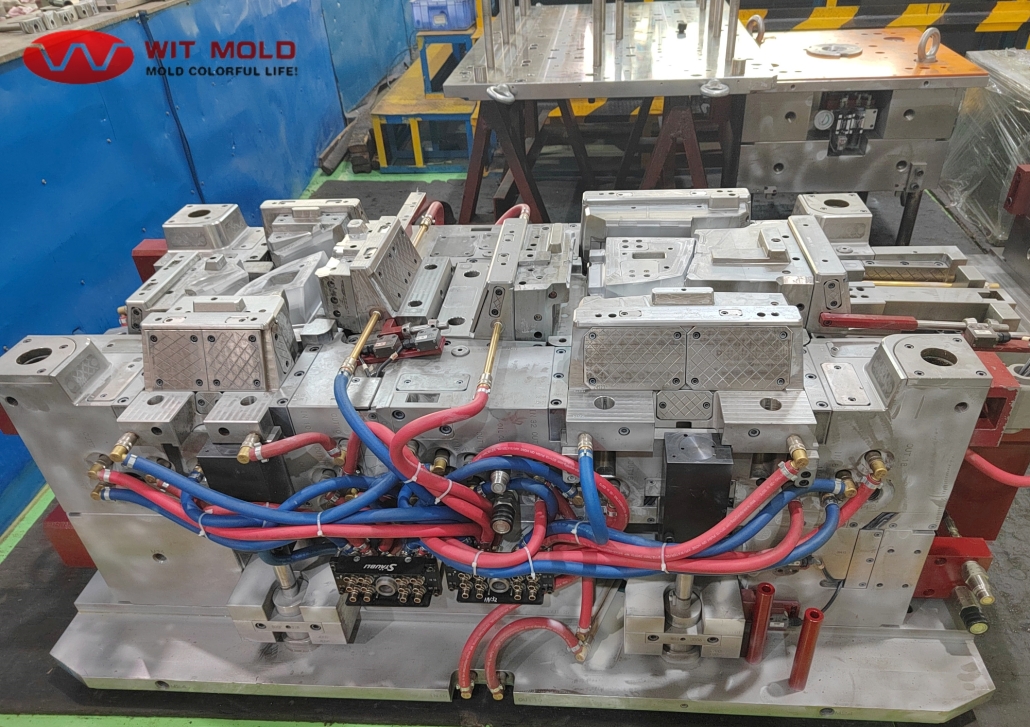
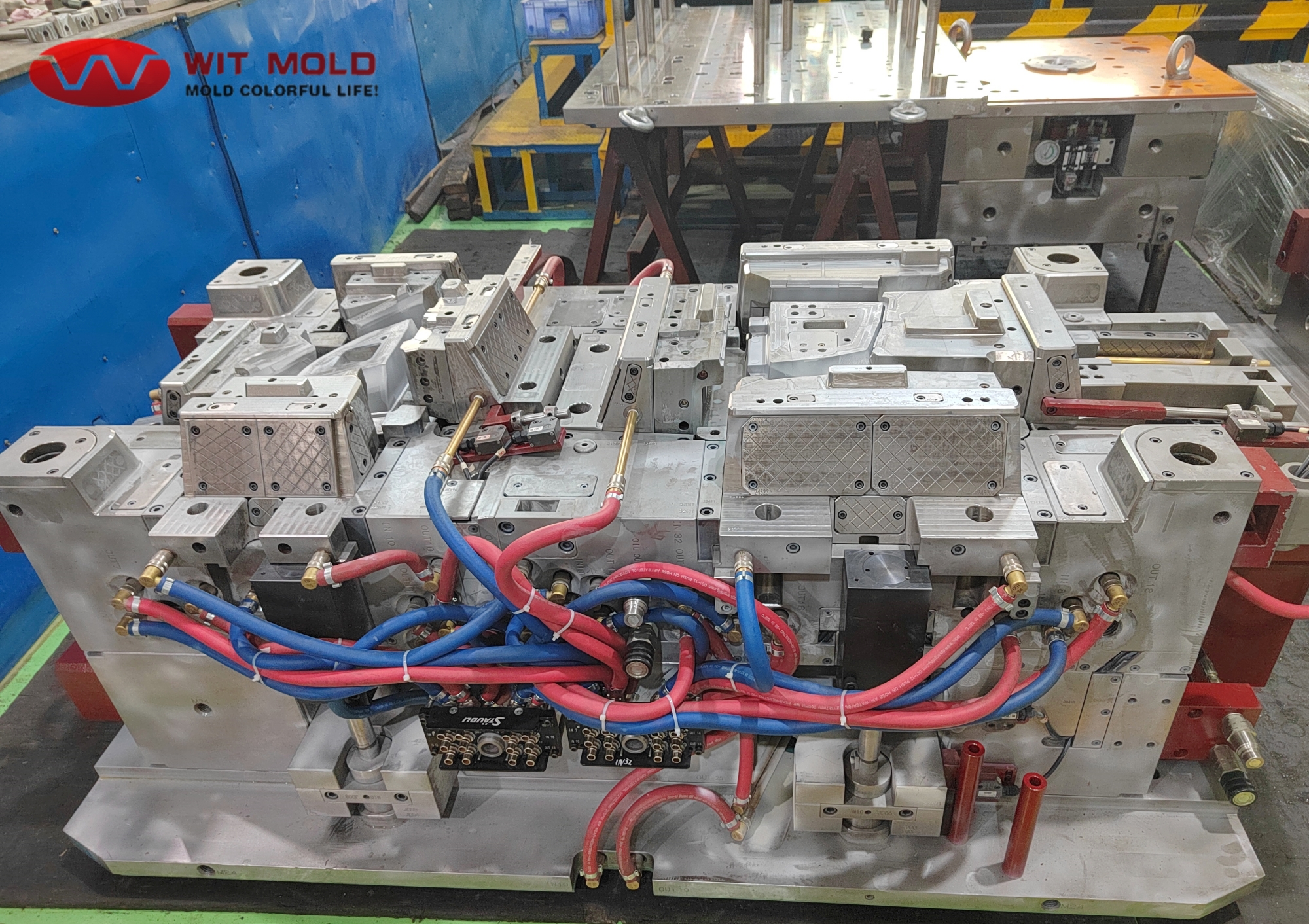
The mold shown in the project image reflects this type of work. Multiple mold structures, cooling connections, moving components, and precision-machined areas need to work together as one complete system. For customers, this means the mold must not only be manufactured correctly, but also run stably in real production.
Why Complex Injection Molds Require More Than Basic Manufacturing
A complex injection mold is not simply a larger or heavier tool. It usually involves more engineering risks and higher coordination requirements.
For example, complex plastic parts may include:
- Deep ribs or thin-wall areas
- Undercuts that require sliders or lifters
- Multiple functional surfaces
- Tight assembly tolerances
- Visible appearance surfaces
- Complex cooling requirements
- Insert areas or special moving structures
- High production volume requirements
If the mold design is not well considered, the customer may face problems such as flash, short shots, sink marks, deformation, poor ejection, unstable dimensions, long cycle times, or difficult maintenance.
This is why complex mold projects require engineering support from the beginning. Before machining starts, the mold maker must understand the part function, material behavior, production requirements, mold life expectations, and the customer’s final application.
Engineering Review Before Mold Manufacturing
For WIT MOLD, engineering review is a critical first step in complex tooling projects.
Before the mold is built, our team evaluates the product structure and considers how the part will be filled, cooled, ejected, and maintained. This helps reduce potential problems before they become costly corrections.
Important review points may include:
| Engineering Area | Why It Matters |
|---|---|
| Parting line design | Affects part appearance, flash control, and mold structure |
| Gate position | Influences filling balance, weld lines, and appearance |
| Cooling layout | Helps control cycle time, warpage, and dimensional stability |
| Slider and lifter design | Supports safe release of undercuts and complex features |
| Steel selection | Affects mold life, wear resistance, and maintenance cost |
| Insert structure | Improves machining feasibility and replacement convenience |
| Ejection method | Helps prevent part deformation, marks, or sticking |
| Mold maintenance access | Supports long-term production efficiency |
A strong mold design can help customers avoid repeated modification, reduce trial time, and improve long-term molding performance.
Precision Manufacturing for Complex Tooling
After the engineering plan is confirmed, precision manufacturing becomes the foundation of mold quality.
Complex molds often include many machined components that must fit accurately. CNC machining, EDM, wire cutting, drilling, grinding, polishing, and component machining all need careful control. A small error in one area may affect the movement, sealing, cooling, or final part dimension.
For complex injection molds, precision manufacturing is especially important in:
- Slider and lifter fitting areas
- Shut-off surfaces
- Core and cavity details
- Insert pockets
- Cooling connection areas
- Ejector systems
- Guide components
- Hot runner or hydraulic-related positions
WIT MOLD focuses on machining accuracy and process control because complex molds must perform as a complete system. Each component must be manufactured correctly, checked carefully, and assembled with the right fitting standard.
Mold Assembly: Turning Components Into a Working System
Mold assembly is one of the most important stages in complex mold manufacturing. At this stage, individual steel components become a functional production tool.
For a complex mold, assembly work requires both technical skill and practical experience. Mold makers need to check whether each component moves smoothly, locks correctly, returns reliably, and works safely with surrounding parts.
The assembly stage usually focuses on:
- Smooth movement of sliders and lifters
- Correct fitting of inserts and cores
- Stable parting surface contact
- Reliable ejector system movement
- Proper cooling line connection
- Accurate mold opening and closing action
- Clean and safe hydraulic or mechanical connections
- Easy access for maintenance and future adjustment
A mold may look complete from the outside, but real quality depends on how well these internal structures work together.
Reducing Project Cost Through Better Engineering
Many buyers focus on the mold price at the beginning of a project. However, the real cost of a mold is not only the initial tooling cost. It also includes trial time, modification cost, production downtime, maintenance, part defect rate, and delivery delays.
A poorly designed or poorly controlled mold may appear cheaper at first, but it can create higher costs later.
WIT MOLD helps customers reduce overall project cost by focusing on:
- Early engineering review
- Practical mold structure design
- Accurate machining
- Careful fitting and assembly
- Controlled trial validation
- Fast response to project feedback
- Reliable shipment preparation
For customers developing automotive parts, household appliances, medical products, telecommunication equipment, smart home devices, consumer electronics, and industrial plastic components, this engineering-driven approach helps make the whole project more predictable.
Shortening Lead Time Without Sacrificing Quality
In B2B mold projects, lead time is often a key concern. Customers may have product launch schedules, assembly test plans, production deadlines, or internal approval timelines.
However, shortening lead time does not mean skipping important steps. For complex molds, rushing without control may lead to more trial problems and longer delays later.
WIT MOLD improves project efficiency by managing each stage clearly:
- Understanding customer requirements before design
- Reviewing key tooling risks early
- Planning machining and component processing properly
- Controlling fitting and assembly details
- Running mold trials with clear validation goals
- Responding quickly to sample feedback
- Preparing the mold carefully before shipment
This process helps reduce unnecessary rework and supports more efficient mold delivery.
Long-Term Performance Matters After Shipment
For overseas customers, mold delivery is not the end of the project. The mold must still perform reliably after it arrives at the customer’s facility or production plant.
A complex mold should support stable molding, repeatable part quality, reasonable cycle time, and convenient maintenance. That is why long-term performance must be considered from the early design stage, not only at final inspection.
WIT MOLD pays attention to mold stability, component durability, cooling efficiency, fitting quality, and maintenance convenience so that customers can use the mold with greater confidence after delivery.
What Buyers Should Provide for a Complex Mold Project
To help the mold manufacturer evaluate the project accurately, buyers should provide complete technical information before quotation and design confirmation.
Useful information includes:
- 2D drawings and 3D product files
- Plastic material and shrinkage requirements
- Annual production volume
- Mold life expectation
- Required surface finish
- Critical tolerances
- Assembly requirements
- Functional testing requirements
- Special mold structure requirements
- Preferred injection machine information, if available
- Any previous sample, prototype, or reference part
The more complete the information is, the easier it is to design a mold that matches the actual production requirements.
WIT MOLD Supports Complex Custom Mold Projects
WIT MOLD provides custom mold manufacturing support for different types of plastic injection mold projects, including:
- Custom plastic injection molds
- High precision molds
- Two shot injection molds
- Unscrewing molds
- Insert molding tools
- High cavitation molds
- Gas assist molds
- Structural foam molds
- Thermoset molds
- BMC molds
- Die casting tools
Our team supports customers from concept review and mold design to precision manufacturing, fitting, trial validation, modification, and final delivery.
For complex mold projects, engineering ability is not optional. It is the key to reducing risk, controlling cost, shortening lead time, and improving long-term production performance.