
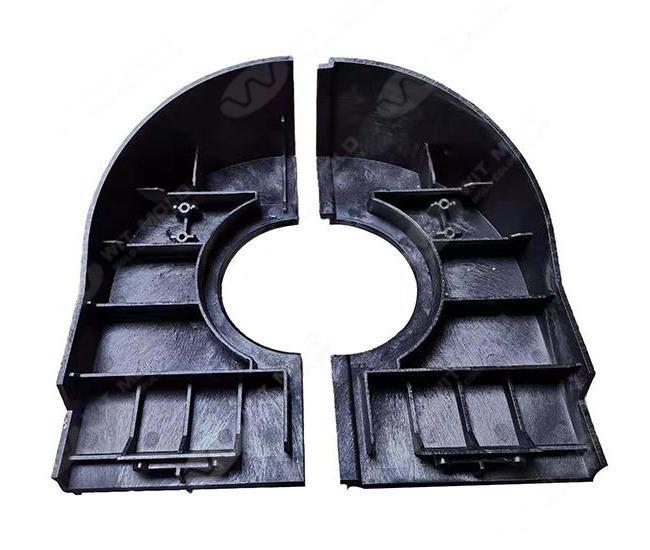
Advantages of Structural Foam Molds for Durable Plastic Parts
Durability is a critical requirement for large plastic components used in industrial machinery, material handling equipment, and commercial products. These parts must withstand mechanical loads, repeated handling, and long-term operating conditions without excessive deformation or premature damage.
Structural foam molding produces components with a cellular inner core surrounded by a relatively dense outer skin. This construction offers a practical combination of rigidity, reduced weight, and design flexibility.
WIT Mold provides custom structural foam molding solutions for large plastic housings, panels, machine components, and industrial equipment enclosures.
1. High Stiffness-to-Weight Ratio
One of the main advantages of structural foam molds is their ability to produce relatively rigid components without requiring completely solid plastic sections.
The cellular core reduces material density, while the outer skin contributes to bending resistance and structural stability.
This is particularly useful for:
- Machine Housings: Large enclosures that require rigidity without excessive weight.
- Industrial Panels: Wide components that must resist bending during handling and installation.
- Equipment Chassis: Structural sections supporting internal components.
- Material Handling Products: Large molded structures where weight and stiffness are important.
WIT Mold’s structural foam molding process supports components with a cellular core and solid outer layers, making it suitable for large structural plastic products.
2. Reduced Warpage and Internal Stress
Large injection molded components can develop warpage because of uneven shrinkage, cooling differences, and residual stress.
Low-pressure structural foam molding can help reduce some of these manufacturing problems.
Key advantages include:
- Lower Cavity Pressure: Can reduce pressure-related stress during molding.
- Improved Dimensional Stability: Suitable foamed structures may experience less distortion.
- Thick-Section Molding: Supports substantial wall sections without requiring completely solid interiors.
- Reduced Sink Marks: Controlled foaming can reduce visible shrinkage around thick features.
These benefits depend on material selection, component geometry, and processing conditions. Structural foam molding does not eliminate all dimensional defects.
3. Better Design Flexibility for Structural Components
Durable plastic products often require reinforcing ribs, mounting bosses, thick walls, and integrated supporting features.
Structural foam molding allows these elements to be incorporated into large molded components.
| Structural Feature | Design Benefit | Typical Application |
|---|---|---|
| Thick Walls | Supports rigid component construction | Equipment housings |
| Reinforcing Ribs | Improves stiffness in selected areas | Industrial panels |
| Mounting Bosses | Integrates fastening features | Machine enclosures |
| Large Structural Sections | Supports complex one-piece designs | Equipment chassis |
| Cellular Core | Reduces material density | Pallets and bulk containers |
Proper rib placement, wall thickness, and load distribution remain essential for achieving the required durability.
4. Impact Resistance for Industrial Applications
Structural foam molded parts can provide suitable impact performance when the correct resin, wall thickness, and component geometry are selected.
The dense outer skin contributes to surface integrity, while the cellular interior influences stiffness, energy absorption, and overall mechanical behavior.
Typical applications include:
- Industrial protective covers exposed to routine handling.
- Material handling containers subject to repeated movement.
- Equipment housings requiring resistance to incidental impacts.
- Commercial products with large structural surfaces.
However, structural foam is not automatically more impact-resistant than solid plastic. Actual performance must be verified using the specified material and appropriate impact testing.
5. Material Selection Influences Long-Term Durability
Different plastic materials provide different mechanical, thermal, and environmental properties.
WIT Mold supports structural foam molding projects using materials such as ABS, PC, PP, and other suitable engineering thermoplastics.
| Material | Relevant Property | Typical Consideration |
|---|---|---|
| ABS | Impact resistance and rigidity | Industrial housings |
| PC | Toughness and impact strength | Protective equipment components |
| PP | Chemical resistance and low density | Containers and material handling products |
| PPO/PPE-Based Materials | Dimensional stability and thermal properties | Industrial equipment parts |
| PBT | Rigidity and dimensional performance | Selected functional components |
Material selection must consider operating temperature, chemical exposure, load conditions, and the specific resin grade.
6. Long-Term Performance Depends on Proper Mold Design
Durability is determined by more than material selection. Mold construction and processing conditions influence foam distribution, surface quality, and finished-part consistency.
Important engineering considerations include:
- Wall Thickness: Maintain appropriate structural dimensions.
- Foam Distribution: Control cellular development throughout suitable sections.
- Gate Location: Support consistent filling of large components.
- Cooling: Reduce uneven shrinkage and deformation.
- Mounting Features: Provide sufficient strength around fastening points.
- Surface Finish: Account for visible flow marks or secondary finishing requirements.
For projects requiring a completely solid structure or fine cosmetic details, conventional plastic molds may provide a more suitable manufacturing approach.
7. How to Verify Durability Before Production
Before approving a structural foam mold, OEM manufacturers should define the mechanical and dimensional requirements of the finished component.
| Inspection or Test | Purpose |
|---|---|
| Dimensional Inspection | Verify critical assembly dimensions |
| Static Load Testing | Evaluate deformation under specified loads |
| Impact Testing | Check resistance to expected impacts |
| Structural Stiffness Testing | Confirm bending performance |
| Environmental Testing | Evaluate behavior under relevant operating conditions |
| Sample Inspection | Check visible defects and molding consistency |
The required tests depend on the product application. Load ratings, impact resistance, and expected service life should not be assumed without project-specific validation.
Frequently Asked Questions
Are structural foam molded parts durable enough for industrial equipment?
Yes, when properly designed and manufactured with suitable materials. Actual durability depends on component geometry, mechanical loads, operating conditions, and testing requirements.
Does structural foam molding reduce plastic part warpage?
It can reduce warpage in suitable thick-walled components through lower-pressure processing and controlled material distribution. Results depend on mold design and processing conditions.
Is structural foam molding suitable for load-bearing components?
It can be suitable for certain load-bearing applications, including pallets and equipment structures. Mechanical strength and long-term deformation must be verified for the intended loads.
Custom Structural Foam Mold Manufacturing With WIT Mold
WIT Mold manufactures custom structural foam molds for large plastic components requiring rigidity, dimensional stability, and dependable structural performance.
Our services cover mold engineering, tooling manufacturing, and production support for industrial housings, plastic panels, equipment components, and material handling products.
We develop tooling according to customer CAD drawings, resin specifications, load requirements, and expected production quantities.
Contact WIT Mold for Structural Foam Mold Manufacturing to discuss your project requirements and request a custom tooling quotation.