
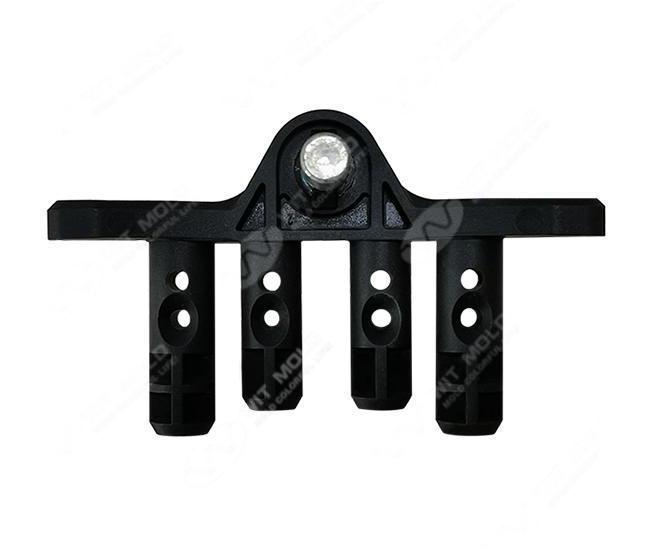
How Precision Injection Molding Improves Plastic Part Accuracy
Dimensional accuracy is critical for plastic components used in electronics, automotive systems, medical equipment, and precision mechanical assemblies. Even small dimensional variations can cause poor fitting, assembly difficulties, or inconsistent product performance.
Precision injection molding improves plastic part accuracy by combining precise mold construction, controlled material shrinkage, stable processing conditions, and dimensional inspection.
WIT Mold specializes in high precision injection molds, supporting OEM manufacturers with precision tooling designed around product geometry, critical tolerances, and production requirements.
1. Precision Mold Design Reduces Dimensional Errors
Plastic part accuracy begins with mold design. The mold cavity must account for the product’s intended dimensions, material shrinkage, and structural characteristics.
Important design considerations include:
- Cavity Dimensions: Accurate cavity geometry helps achieve the required part dimensions.
- Gate Position: Proper gate placement supports balanced filling and reduces uneven shrinkage.
- Parting Surfaces: Accurate fitting helps minimize flash and dimensional mismatch.
- Ejection Design: Suitable ejector placement reduces the risk of part deformation.
- Cooling Layout: Balanced cooling helps prevent warpage and dimensional variation.
A well-designed mold reduces the need for repeated adjustments during production.
2. Precision Machining Improves Mold Accuracy
The dimensional accuracy of molded parts depends heavily on the quality of mold machining and assembly.
CNC machining, EDM, grinding, and other precision manufacturing processes are used to produce accurate mold cavities and components.
WIT Mold’s precision mold manufacturing capabilities include high-accuracy machining, with mold component tolerances specified as tight as ±0.002 mm for applicable projects. This represents a tooling capability, not a guaranteed tolerance for every molded plastic part.
Critical machining factors include:
- Accurate cavity and core dimensions.
- Precise insert positioning.
- Consistent alignment of mold components.
- Controlled machining and assembly errors.
Proper machining helps reduce dimensional deviations and supports consistent mold operation.
3. Material Shrinkage Control Maintains Part Dimensions
Plastic materials shrink as they cool and solidify. Different resin grades have different shrinkage characteristics, which must be considered during tooling design.
| Material | Main Dimensional Concern | Control Consideration |
|---|---|---|
| ABS | Uneven shrinkage and sink marks | Wall thickness and cooling |
| PC | Residual stress and dimensional stability | Processing temperature and cooling |
| PP | Relatively high shrinkage and warpage | Cavity compensation and cooling balance |
| PA (Nylon) | Moisture-related dimensional changes | Material conditioning and shrinkage control |
| POM | Crystallization-related shrinkage | Temperature and processing consistency |
Accurate shrinkage compensation helps molded parts achieve their intended dimensions after cooling.
The specific resin grade, geometry, and processing conditions must be considered rather than relying on a single general shrinkage value.
4. Stable Injection Molding Conditions Improve Repeatability
Even a precisely manufactured mold cannot guarantee accurate parts without stable injection molding conditions.
Variations in melt temperature, injection pressure, packing pressure, and cooling time can affect part dimensions.
Important process controls include:
- Injection Pressure and Speed: Support consistent cavity filling.
- Packing Pressure: Compensates for material shrinkage during solidification.
- Mold Temperature: Influences cooling behavior and dimensional stability.
- Cooling Time: Allows sufficient solidification before ejection.
- Process Repeatability: Reduces dimensional variation between production cycles.
Consistent processing conditions are essential for maintaining accuracy during repeated production.
5. Dimensional Inspection Verifies Molded Part Accuracy
Precision injection molding requires inspection to confirm that finished components meet specified tolerances.
WIT Mold uses a quality management system covering machining, mold assembly, trials, and inspection.
Common verification methods include:
| Inspection Method | Purpose |
|---|---|
| Coordinate Measuring Machine (CMM) | Measures critical three-dimensional features |
| Optical Measurement | Checks small features and profiles |
| Calipers and Micrometers | Verify suitable dimensional characteristics |
| Functional Gauges | Confirm assembly and fitting requirements |
| Sample Comparison | Evaluates consistency against approved samples |
The inspection method should match the required tolerance, feature geometry, and measurement uncertainty.
How Precision Injection Molding Affects Product Performance
Improved dimensional control provides important advantages for components with demanding functional requirements.
- Better Assembly Fit: Components align more consistently during assembly.
- Reduced Dimensional Variation: Production parts remain closer to specified dimensions.
- Improved Mechanical Function: Gears, connectors, and moving components operate with more consistent geometry.
- Fewer Rejected Parts: Effective process control can reduce defects caused by dimensional deviations.
- Greater Production Consistency: Stable tooling and processing support repeatable part quality.
However, achievable tolerances depend on material, geometry, mold design, manufacturing equipment, and inspection conditions.
Frequently Asked Questions
What determines the accuracy of precision injection molded parts?
Accuracy depends on mold machining, cavity design, plastic material shrinkage, molding parameters, cooling conditions, and dimensional inspection.
Can precision injection molding achieve ±0.002 mm tolerance?
A mold component may be machined to ±0.002 mm under suitable conditions, but this does not mean the finished plastic part will achieve the same tolerance. Molded part accuracy must be evaluated according to material, geometry, and production conditions.
How can dimensional variation be reduced in mass production?
Consistent material preparation, stable injection molding parameters, controlled cooling, and regular dimensional inspection help reduce variation between production cycles.
Precision Injection Mold Manufacturing With WIT Mold
WIT Mold manufactures precision injection molds for plastic components requiring accurate geometry, consistent assembly, and reliable production performance.
Our manufacturing process includes mold design, precision machining, assembly, mold trials, and quality inspection to support customer-specific dimensional requirements.
Contact WIT Mold to submit your CAD drawings, critical tolerances, material specifications, and production requirements for a precision injection mold quotation.