
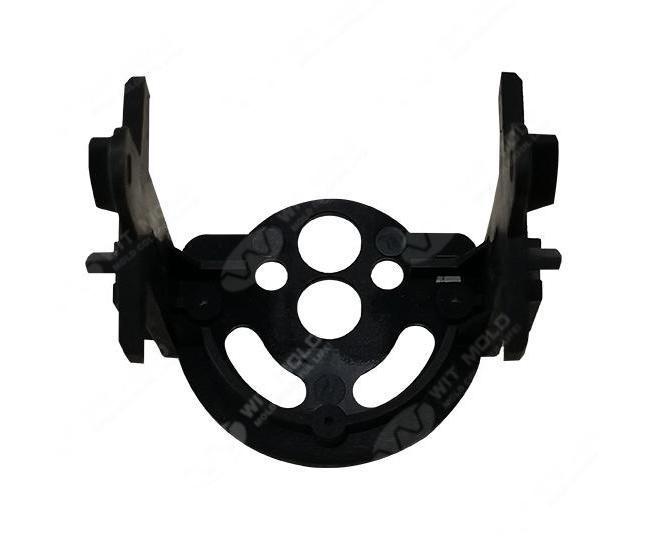
Why Manufacturers Choose High Precision Plastic Molds
Manufacturers increasingly rely on high precision plastic molds to produce components requiring accurate dimensions, consistent assembly, and reliable performance. For OEM projects involving complex parts or demanding tolerances, conventional tooling may not provide sufficient dimensional control.
WIT Mold specializes in precision injection molding and high-precision mold manufacturing for automotive, electronics, medical equipment, and industrial applications. Our precision tooling capabilities support detailed component geometries and demanding production requirements.
1. Improve Assembly Accuracy and Product Fit
Plastic components often need to fit precisely with other molded parts, metal components, or electronic assemblies. Dimensional variations can cause misalignment, loose connections, or assembly difficulties.
High precision molds help maintain critical dimensions through accurate cavity construction and controlled mold alignment.
Common applications include:
- Electronic Connectors: Accurate positioning of contact openings and retaining features.
- Automotive Components: Consistent fitting dimensions for housings and mechanical assemblies.
- Precision Gears: Controlled tooth geometry for reliable mechanical engagement.
- Medical Equipment Components: Accurate fitting of plastic parts within device assemblies.
Better dimensional consistency can reduce manual adjustments during downstream assembly.
2. Reduce Defects and Improve Production Yield
Dimensional deviations, flash, warpage, and inconsistent filling can increase rejection rates during plastic part production.
High precision tooling helps address these problems through accurate machining, appropriate mold design, and stable component fitting.
| Common Production Problem | Precision Tooling Contribution |
|---|---|
| Dimensional Variation | Accurate cavity geometry and alignment |
| Excessive Flash | Controlled parting surface fitting |
| Assembly Misalignment | Consistent critical dimensions |
| Part Deformation | Suitable cooling and ejection design |
| Inconsistent Cavity Output | Accurate cavity manufacturing and balancing |
Although precision molds cannot eliminate every molding defect, they provide a stronger foundation for stable processing and quality control.
WIT Mold follows an integrated quality control process covering mold design, machining, assembly, trials, and final inspection.
3. Support Complex and Miniature Plastic Components
Products with small features, intricate geometries, or closely spaced structures require careful tooling construction.
High precision molds can accommodate:
- Thin ribs and detailed internal structures.
- Small holes, slots, and positioning features.
- Complex cavities and precision inserts.
- Tight-fitting mechanical components.
- Detailed surfaces requiring accurate mold finishing.
WIT Mold manufactures precision mold components with machining tolerances as tight as ±0.002 mm for applicable projects. Actual molded-part tolerances depend on material properties, geometry, and processing conditions.
This capability is especially relevant for components requiring accurate assembly or detailed functional features.
4. Maintain Consistency During High-Volume Production
For manufacturers producing large quantities of identical plastic parts, repeatability is essential.
Small dimensional differences between production cycles or mold cavities can create assembly problems and increase inspection requirements.
Precision mold manufacturing supports production consistency through:
- Accurate cavity and core positioning.
- Controlled mold component alignment.
- Consistent parting surfaces and ejection mechanisms.
- Suitable cooling and runner configurations.
- Dimensional verification during mold trials.
For projects requiring higher output, WIT Mold also manufactures high cavitation molds with configurations selected according to production requirements.
5. Balance Initial Tooling Investment With Long-Term Costs
High precision plastic molds may require additional machining, inspection, and engineering work, increasing initial tooling investment.
However, better tooling accuracy and reliable operation can reduce costs associated with defective parts, assembly adjustments, and repeated mold corrections.
| Cost Consideration | Potential Long-Term Benefit |
|---|---|
| Precision Machining | Reduced dimensional errors |
| Accurate Mold Assembly | More reliable mechanical operation |
| Consistent Part Quality | Lower potential rejection and rework costs |
| Durable Mold Components | Reduced risk of premature tooling wear |
| Stable Production | More predictable manufacturing output |
The actual financial benefit depends on production volume, part complexity, achievable yield, and maintenance conditions.
High precision molds are most valuable when dimensional requirements and production economics justify the additional tooling investment.
When Should Manufacturers Invest in High Precision Molds?
Not every plastic product requires precision tooling. The investment is generally more appropriate when:
- Components have tight dimensional or geometric tolerances.
- Parts contain intricate features or miniature structures.
- Multiple components must fit together accurately.
- Dimensional variation could affect product functionality.
- High-volume manufacturing requires consistent part quality.
For simple plastic covers or components with wider tolerances, conventional injection molds may provide a more economical solution.
Frequently Asked Questions
Are high precision plastic molds more expensive?
They often involve higher initial costs because of additional machining accuracy, specialized components, and inspection requirements. However, they may reduce long-term production expenses when tight tolerances and consistency are essential.
Do precision molds automatically guarantee accurate plastic parts?
No. Mold accuracy is important, but finished-part dimensions also depend on material shrinkage, injection molding parameters, cooling conditions, and product geometry.
Which products benefit most from high precision injection molding?
Precision gears, electrical connectors, sensor housings, detailed mechanical components, and other products with demanding assembly or dimensional requirements are common examples.
High Precision Plastic Mold Manufacturing With WIT Mold
WIT Mold manufactures custom high precision injection molds for OEM projects requiring detailed mold structures, dimensional control, and reliable manufacturing performance.
With mold manufacturing experience since 2011, we provide precision tooling design, machining, mold assembly, trial molding, and inspection based on customer specifications.
Contact WIT Mold to submit your CAD drawings, critical tolerances, plastic material requirements, and production quantities for a custom precision mold quotation.