
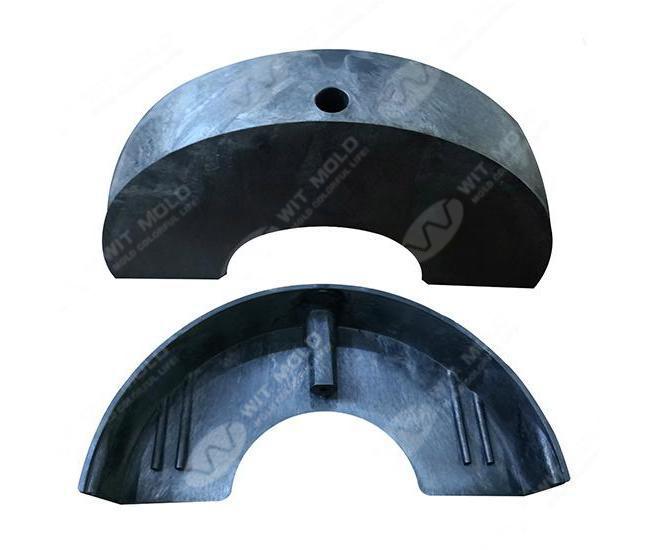
How Structural Foam Injection Molding Handles Large Products
Manufacturing large plastic products presents challenges that become more significant as component dimensions increase. Long flow paths, thick walls, uneven cooling, and high mold cavity pressures can affect part quality and manufacturing costs.
Structural foam molding addresses these challenges through a foaming process that forms a cellular core surrounded by a dense outer skin. The process is particularly suitable for large plastic components requiring substantial wall thickness and structural rigidity.
WIT Mold provides structural foam molding solutions for large machine housings, plastic panels, equipment enclosures, and industrial components. Our tooling development focuses on product geometry, material flow, and manufacturing feasibility.
1. Fill Large Mold Cavities at Lower Pressure
One of the main challenges in manufacturing large plastic parts is filling the entire mold cavity without excessive injection pressure.
In low-pressure structural foam molding, gas or a blowing agent expands within the molten plastic, helping the material fill the cavity.
This provides several manufacturing advantages:
- Lower Cavity Pressure: Foaming assists cavity filling without relying entirely on high packing pressure.
- Large Component Manufacturing: Supports products with substantial dimensions and thick structural sections.
- Reduced Internal Stress: Lower-pressure processing can reduce certain molding-related stresses.
- Tooling Flexibility: Suitable low-pressure designs may allow different mold construction approaches.
The required injection pressure still depends on component dimensions, material flow properties, and wall thickness.
2. Handle Thick Walls and Structural Features
Large industrial products often require thick walls, mounting bosses, ribs, and integrated supporting features.
In conventional injection molding, these sections can create sink marks or require extended cooling periods.
Structural foam molding accommodates thicker sections by creating a cellular internal structure.
| Product Feature | Manufacturing Challenge | Structural Foam Solution |
|---|---|---|
| Thick Walls | Long cooling time and shrinkage | Cellular core reduces solid material |
| Large Flat Panels | Warpage and distortion | Foaming pressure helps compensate for shrinkage |
| Reinforcing Ribs | Sink marks at wall intersections | Reduced sink risk in suitable designs |
| Mounting Bosses | Material accumulation | Integrated thick-section molding |
| Large Enclosures | High filling pressure | Low-pressure foam-assisted filling |
WIT Mold manufactures structural foam tooling for large covers, handles, panels, and equipment components.
3. Control Material Flow Across Large Components
Long flow distances can make it difficult to distribute molten plastic uniformly across large mold cavities.
Structural foam molding uses gas expansion to assist filling, but gate position, wall thickness, and flow paths remain important.
Critical design considerations include:
- Gate Placement: Supports material distribution across the component.
- Wall Thickness: Affects flow resistance and cellular development.
- Flow Ribs: May assist filling in suitable large geometries.
- Venting: Allows displaced air and gases to escape appropriately.
- Material Selection: Determines melt flow behavior and foaming characteristics.
Poor flow design may cause incomplete filling, irregular foam distribution, or dimensional inconsistencies.
For large components, engineering review should evaluate these factors before tooling production.
4. Reduce Warpage in Large Plastic Parts
Large plastic components are particularly sensitive to uneven shrinkage and cooling.
Structural foam molding uses internal gas pressure during solidification, helping compensate for material shrinkage.
Potential benefits include:
- Reduced sink marks in thick sections.
- Lower residual stress in suitable designs.
- Improved dimensional stability of large panels.
- Reduced risk of deformation around structural features.
However, the process does not guarantee warpage-free products. Cooling conditions, resin properties, and part geometry still influence finished dimensions.
5. Support Large One-Piece Plastic Products
Structural foam molding can make certain large integrated components more practical to manufacture.
Instead of assembling several smaller plastic sections, suitable products can be designed as a single molded part.
| Product Application | Main Manufacturing Requirement |
|---|---|
| Industrial Machine Housings | Large structural shells with mounting features |
| Equipment Panels | Dimensional stability across wide surfaces |
| Plastic Pallets | Integrated supporting structures |
| Commercial Display Components | Large rigid molded sections |
| Machine Chassis Components | Structural geometry and assembly features |
Producing larger one-piece components can reduce assembly interfaces, although tooling size, transportation, and handling requirements must also be considered.
6. Consider Surface Finish Requirements
Structural foam molded products may have visible swirl marks or surface irregularities caused by the foaming process.
For industrial components, these characteristics may be acceptable. Products requiring smooth cosmetic surfaces may need painting, sanding, or additional finishing.
For parts requiring fine details, thin walls, or demanding cosmetic surfaces, conventional plastic molds may be more appropriate.
The manufacturing process should be selected according to both structural and appearance requirements.
7. Confirm Manufacturing Feasibility Before Tooling
Large structural foam projects require careful evaluation of mold dimensions, equipment capacity, and product performance.
| Project Requirement | Information to Confirm |
|---|---|
| Component Size | Overall dimensions and mold envelope |
| Plastic Material | Resin grade and foaming compatibility |
| Wall Thickness | Nominal thickness and structural variations |
| Mechanical Performance | Stiffness, impact, and loading requirements |
| Surface Finish | Acceptable appearance and finishing operations |
| Production Quantity | Estimated annual demand |
| Equipment Compatibility | Suitable molding capacity and tooling configuration |
WIT Mold develops custom structural foam molds based on customer drawings and production requirements. Mold trials and sample verification help confirm the suitability of the selected tooling approach.
Frequently Asked Questions
Why is structural foam molding suitable for large plastic parts?
Its low-pressure filling characteristics and ability to form thick cellular sections make it suitable for many large structural components.
Can structural foam molding produce large parts without assembly?
Yes. Suitable products can be manufactured as one-piece components, depending on mold dimensions, equipment capacity, and part geometry.
Does structural foam molding require thicker walls?
Structural foam molding generally favors relatively thick sections that allow effective cellular development. The required thickness depends on resin properties, structural requirements, and the selected molding process.
Custom Structural Foam Molds for Large Plastic Products
WIT Mold manufactures custom structural foam molds for large industrial plastic components, including machine housings, panels, covers, and equipment enclosures.
Our services cover mold engineering, tooling manufacturing, and project-specific sample verification. We develop tooling according to customer CAD drawings, resin specifications, structural requirements, and production volumes.
Contact WIT Mold to submit your large plastic component drawings and request a custom structural foam mold quotation.