
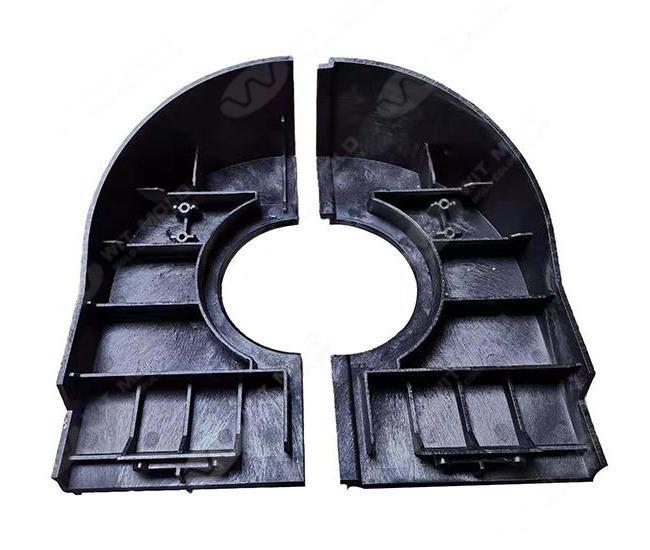
Design Considerations for Structural Foam Mold Manufacturing
Structural foam molding requires careful engineering to achieve consistent material flow, controlled cellular structures, and reliable dimensional performance. Unlike conventional injection molding, the process creates a relatively dense outer skin surrounding a lower-density cellular core, making it particularly suitable for large and thick-walled plastic components.
WIT Mold manufactures custom structural foam molds for industrial housings, equipment panels, plastic covers, and other large components. Successful tooling development depends on several important design considerations.
1. Optimize Wall Thickness and Transitions
Wall thickness directly affects material flow, foam development, cooling, and structural performance.
Structural foam molding generally accommodates thicker sections than conventional injection molding, but extremely thin walls may limit effective cellular development.
Important design principles include:
- Wall Thickness: Select dimensions that support material flow and the required cellular structure.
- Uniform Sections: Maintain consistent thickness where practical to reduce irregular filling.
- Gradual Transitions: Use appropriate radii and tapered transitions between different wall sections.
- Structural Requirements: Determine thickness according to mechanical loads and stiffness requirements.
A nominal wall thickness around 6.35 mm is frequently referenced in structural foam design guidance, but it is not a universal requirement. The appropriate thickness depends on material, geometry, and molding equipment.
2. Design Gates and Flow Paths for Large Components
Large structural foam components often contain long flow paths and substantial variations in cross-section.
Gate locations must allow molten material to reach the required areas before excessive cooling or uncontrolled foaming occurs.
| Design Factor | Engineering Consideration |
|---|---|
| Gate Location | Support balanced filling throughout the cavity |
| Flow Length | Match material flow capability to part dimensions |
| Wall Transitions | Avoid abrupt changes that restrict flow |
| Flow Ribs | Improve filling of difficult areas where appropriate |
| Venting | Allow displaced air and gases to escape |
| Filling Pattern | Reduce incomplete filling and irregular foam distribution |
WIT Mold’s design and engineering services include DFM analysis, mold flow analysis, and structural analysis to support tooling development.
3. Control Foam Distribution and Part Density
Structural foam molding relies on gas expansion to form a cellular core within the plastic component.
Uneven foam distribution can affect part weight, rigidity, dimensions, and surface appearance.
Key variables include:
- Blowing Agent Selection: Determine compatibility with the resin and molding process.
- Melt Temperature: Control material flow and foaming behavior.
- Injection Pressure: Maintain suitable filling conditions for the selected process.
- Foam Expansion: Control the formation and distribution of internal cells.
- Cooling Conditions: Support stable solidification and dimensional consistency.
Material selection must account for the intended mechanical performance rather than focusing exclusively on density reduction.
WIT Mold supports structural foam applications using materials including ABS, PC, PP, and PS, with the final resin grade selected according to project requirements.
4. Incorporate Ribs, Bosses, and Mounting Features
Large plastic products frequently require reinforcing ribs, mounting bosses, inserts, and other structural features.
Structural foam molding can accommodate relatively thick sections, allowing some supporting features to be integrated directly into the component.
| Structural Feature | Design Requirement | Potential Problem |
|---|---|---|
| Reinforcing Ribs | Appropriate thickness and positioning | Uneven filling or deformation |
| Mounting Bosses | Sufficient material around fasteners | Cracking or local weakness |
| Structural Supports | Suitable load distribution | Excessive deflection |
| Molded Inserts | Accurate positioning and retention | Assembly misalignment |
| Thick-to-Thin Transitions | Gradual geometry changes | Irregular material flow |
Mechanical loads and fastening requirements should be established before finalizing the tooling design.
5. Plan Mold Cooling and Part Ejection
Cooling and ejection affect the dimensional stability and appearance of large structural foam components.
Poor temperature control can contribute to uneven shrinkage, distortion, or inconsistent foam development.
Important considerations include:
- Cooling Channel Layout: Provide appropriate temperature control across large mold surfaces.
- Draft Angles: Allow reliable release without damaging the molded part.
- Ejection Position: Distribute ejection forces across suitable structural areas.
- Parting Line Location: Avoid interfering with critical assembly or appearance features.
- Mold Venting: Prevent trapped gas and filling defects.
Ejection mechanisms must accommodate the component’s weight, geometry, and required surface quality.
6. Define Surface Finish Requirements Early
Structural foam molded parts may exhibit visible swirl marks or surface irregularities because of gas expansion during molding.
For industrial equipment housings, these finishes may be acceptable. Consumer-facing products or visible panels may require additional finishing.
| Surface Requirement | Manufacturing Consideration |
|---|---|
| Functional Industrial Surface | As-molded finish may be acceptable |
| Textured Surface | Evaluate texture compatibility |
| Smooth Cosmetic Finish | Additional finishing may be required |
| Painted Components | Confirm surface preparation and coating requirements |
| Critical Assembly Surface | Define dimensional and flatness requirements |
For thin-walled parts with demanding cosmetic requirements, conventional plastic molds may offer a more suitable manufacturing approach.
7. Validate Mold Design Before Production
Structural foam mold trials should verify both manufacturing consistency and the finished component’s functional performance.
Important inspection requirements include:
- Dimensional Accuracy: Check critical dimensions against approved drawings.
- Part Weight: Confirm consistency with the agreed weight or density target.
- Surface Quality: Evaluate visible defects and finishing requirements.
- Structural Performance: Verify stiffness, load capacity, or impact resistance where specified.
- Foam Distribution: Assess internal cellular structure when required by the application.
Before ordering, provide complete CAD drawings, material specifications, wall thickness requirements, structural loads, and expected production quantities.
Frequently Asked Questions
What wall thickness is suitable for structural foam molding?
Structural foam molding generally favors thicker sections. Around 6.35 mm is a commonly referenced nominal design thickness, but the actual requirement depends on resin selection, geometry, and process conditions.
Why is gate location important in structural foam molding?
Gate placement influences filling, foam distribution, and material flow across large components. Poor placement may cause incomplete filling or inconsistent internal structure.
Can structural foam molds produce parts with reinforcing ribs?
Yes. Reinforcing ribs, mounting bosses, and structural supports can be integrated into suitable designs. Their dimensions and placement must support material flow and mechanical requirements.
Custom Structural Foam Mold Design With WIT Mold
WIT Mold manufactures structural foam molds for large plastic components requiring integrated structural features, controlled material distribution, and reliable manufacturing performance.
Our services include DFM analysis, mold flow analysis, tooling design, manufacturing, and sample verification based on customer specifications.
Contact WIT Mold to submit your CAD drawings, resin specifications, structural requirements, and production quantities for a custom structural foam mold quotation.