
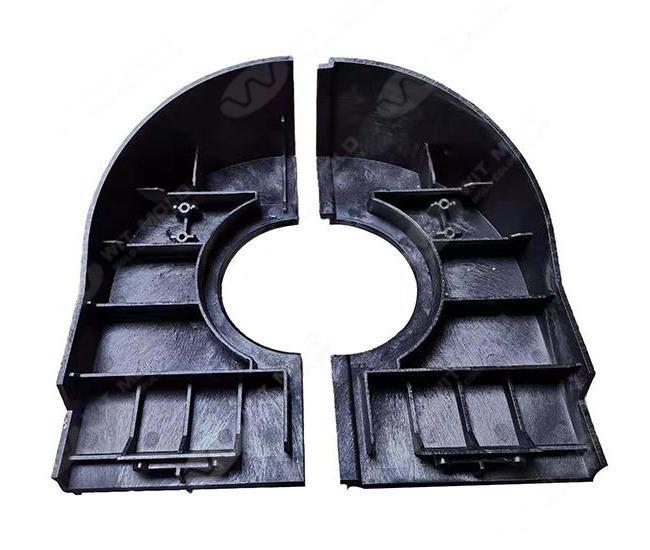
Structural Foam Molding Applications for Large Plastic Components
Manufacturing large plastic components requires suitable structural strength, dimensional stability, and manageable production costs. Conventional injection molding can present challenges when producing thick-walled parts, large housings, and components with integrated supporting features.
Structural foam molding offers an alternative by creating plastic parts with a cellular core and a relatively dense outer skin. This structure can reduce material consumption while providing useful stiffness for large components.
WIT Mold provides custom structural foam molding solutions for industrial equipment, commercial products, material handling systems, and other large plastic components.
1. Industrial Machine Housings and Enclosures
Industrial machinery often requires large protective housings with sufficient rigidity, mounting features, and dimensional stability.
Structural foam injection molding is suitable for manufacturing:
- Machine Housings: Large plastic covers protecting internal equipment.
- Equipment Enclosures: Structural shells for industrial machinery.
- Machine Chassis Components: Plastic supports and structural sections.
- Protective Panels: Large covers with integrated mounting features.
The cellular core reduces material density, while the outer skin contributes to structural performance.
WIT Mold manufactures structural foam tooling for large plastic covers, panels, enclosures, and equipment components.
2. Material Handling Pallets and Containers
Pallets, bulk containers, and industrial storage products often require thick sections and durable construction.
Structural foam molding can accommodate large geometries and integrated reinforcing features.
| Product | Manufacturing Requirement | Structural Foam Advantage |
|---|---|---|
| Plastic Pallets | Stiffness and load-bearing capacity | Lightweight structural construction |
| Bulk Containers | Large dimensions and impact resistance | Integrated thick sections |
| Industrial Storage Boxes | Durable walls and reinforcing features | Reduced material in suitable designs |
| Material Handling Carts | Structural rigidity and manageable weight | Large molded components |
Load capacity, impact performance, and durability must be verified for the intended application. Structural foam construction alone does not guarantee a particular load rating.
3. Commercial Displays and Retail Equipment
Large retail display structures often require rigid plastic panels, supporting frames, and stable mounting surfaces.
Structural foam molding is used for point-of-sale displays, retail stands, shelving components, and commercial equipment structures.
Key manufacturing advantages include:
- Large Component Size: Suitable for panels and supporting structures.
- Integrated Features: Mounting points and reinforcing sections can be incorporated into the molded part.
- Material Efficiency: The cellular core reduces the amount of solid plastic required.
- Structural Stability: Suitable designs provide rigidity for display and equipment applications.
Surface appearance is an important consideration. Structural foam molded components may have visible swirl patterns or uneven surface textures, making painting or secondary finishing necessary for cosmetic applications.
4. Medical and Laboratory Equipment Housings
Medical and laboratory equipment often requires large plastic enclosures with mounting features, internal support structures, and suitable dimensional stability.
Potential structural foam molding applications include:
- Diagnostic equipment enclosures.
- Laboratory instrument housings.
- Medical equipment covers.
- Large equipment support panels.
WIT Mold supplies molded plastic covers, panels, and enclosures for medical and laboratory equipment applications.
Material selection, cleaning requirements, surface finish, and applicable regulatory specifications must be evaluated according to the finished product.
5. Outdoor and Agricultural Plastic Products
Structural foam molding is also suitable for certain large outdoor products requiring rigid construction and reduced material density.
Common applications include:
- Outdoor storage containers and sheds.
- Agricultural equipment panels.
- Garden carts and utility products.
- Outdoor furniture components.
- Fencing and construction panels.
For outdoor products, resin selection must account for UV exposure, weather resistance, temperature variation, and mechanical loading.
Comparing Structural Foam Molding Applications
| Application | Main Product Requirement | Key Tooling Consideration |
|---|---|---|
| Industrial Housings | Rigidity and integrated features | Large cavity design |
| Pallets and Containers | Load-bearing performance | Wall thickness and reinforcement |
| Retail Displays | Structural stability and appearance | Surface finish requirements |
| Medical Equipment Covers | Dimensional stability and assembly | Mounting features and material selection |
| Outdoor Products | Durability and environmental resistance | Resin compatibility and part geometry |
6. When Is Structural Foam Molding the Right Choice?
Structural foam molding is particularly suitable for medium-to-large plastic parts requiring thicker sections, integrated structural features, and reduced material density.
However, it is not the best solution for every large plastic component.
| Product Requirement | Manufacturing Consideration |
|---|---|
| Large, Thick-Walled Components | Structural foam molding is a strong candidate |
| Rigid Structural Panels | Suitable after mechanical evaluation |
| Lightweight Equipment Housings | Can reduce material consumption |
| High-Gloss Cosmetic Surfaces | May require additional finishing |
| Thin-Walled Precision Components | Conventional injection molding may be more appropriate |
| Hollow Tubular Structures | Gas assisted injection molding may be more suitable |
Unlike gas assist molds, which can create defined hollow channels within selected thick sections, structural foam molds produce a cellular internal structure distributed through suitable regions of the molded part.
The appropriate process depends on product geometry, material selection, mechanical requirements, and surface specifications.
7. Key Requirements Before Ordering Structural Foam Molds
Large structural foam components require careful evaluation before tooling production.
Important project details include:
- CAD Drawings: Complete geometry, mounting features, and structural sections.
- Material Requirements: Specify the resin grade and performance expectations.
- Wall Thickness: Define suitable structural dimensions and transitions.
- Mechanical Loads: Provide load-bearing, stiffness, and impact requirements.
- Surface Finish: Confirm whether texture, painting, or additional finishing is acceptable.
- Production Volume: Estimate annual quantities and tooling life requirements.
WIT Mold supports structural foam mold development according to customer drawings and project specifications.
Frequently Asked Questions
What products are commonly manufactured using structural foam molding?
Common applications include machine housings, pallets, industrial containers, retail displays, equipment enclosures, and large structural panels.
Is structural foam molding suitable for large load-bearing plastic parts?
It can be suitable when the material, wall thickness, and part geometry meet the required mechanical specifications. Load-bearing capacity must be verified through engineering analysis and testing.
What is the difference between structural foam molding and conventional injection molding?
Structural foam molding creates a cellular core with a denser outer skin, while conventional injection molding generally produces solid plastic sections. Structural foam molding can offer advantages for large, thick-walled parts, but may require additional surface finishing.
Custom Structural Foam Mold Manufacturing With WIT Mold
WIT Mold manufactures custom structural foam molds for large plastic components used in industrial equipment, commercial products, medical equipment housings, and material handling applications.
Our services cover mold engineering, tooling manufacturing, and production-related support based on customer drawings, material specifications, and structural requirements.
Contact WIT Mold to submit your large plastic component drawings and request a structural foam mold quotation.