
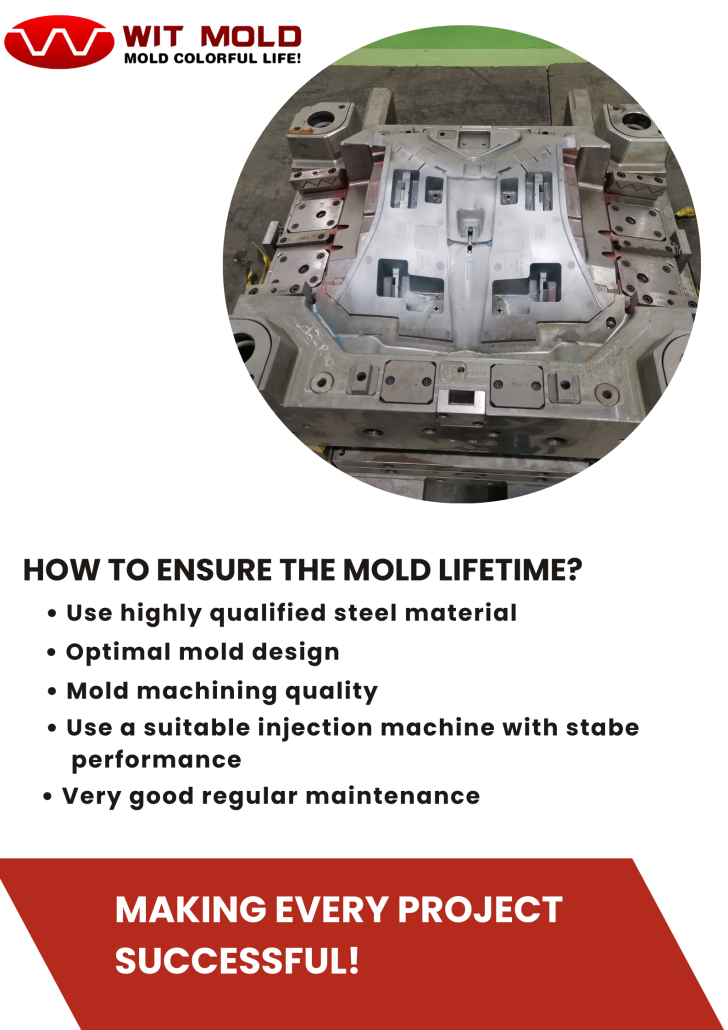
How to Extend Mold Lifetime: Key Factors from Design to Maintenance
Mold lifetime is one of the most important factors affecting production efficiency and overall manufacturing costs. A mold with longer service life can help reduce replacement frequency, minimize downtime, and maintain stable product quality during mass production.
However, long mold lifetime is not achieved by chance. It requires continuous quality control throughout the entire process, from material selection and mold design to machining, injection molding, and regular maintenance.
WIT Mold focuses on controlling every critical stage to help customers achieve reliable and durable mold performance.
1. Use High-Quality Steel Materials
The selection of mold steel directly affects mold durability, wear resistance, and production capability.
High-quality steel materials provide better performance under repeated injection cycles, helping molds maintain structural stability and dimensional accuracy over long-term production.
Material selection should consider:
- Production volume requirements
- Plastic material characteristics
- Mold structure complexity
- Working conditions
Choosing suitable steel according to the application helps prevent premature wear and extends mold service life.
2. Optimize Mold Design Before Manufacturing
A well-designed mold provides a strong foundation for long-term operation.
Proper mold design helps improve:
- Structural strength
- Cooling efficiency
- Ejection performance
- Production stability
Key design considerations include:
- Appropriate mold structure
- Optimized cooling system
- Balanced filling design
- Easy maintenance structure
Good design reduces unnecessary stress on mold components and helps maintain stable performance during repeated production cycles.
3. Ensure High Mold Machining Quality
Precision machining quality directly influences mold accuracy and lifetime.
During mold manufacturing, accurate machining helps ensure:
- Correct component dimensions
- Proper fitting between mold parts
- Stable mold operation
- Reduced wear caused by poor alignment
High-quality machining processes help prevent problems such as premature damage, uneven wear, and production instability.
4. Use Injection Machines with Stable Performance
Even a well-designed and well-manufactured mold requires a suitable injection machine to achieve long service life.
A stable injection molding machine helps maintain:
- Consistent injection pressure
- Stable production parameters
- Proper clamping force
- Reduced impact on mold components
Using equipment that matches mold requirements helps avoid unnecessary stress and extends mold operating life.
5. Perform Regular Mold Maintenance
Regular maintenance is essential for keeping molds in good working condition.
Maintenance activities may include:
- Cleaning mold surfaces
- Checking moving components
- Applying proper lubrication
- Inspecting wear parts
- Checking cooling channels
Timely maintenance helps identify potential issues before they affect production and prevents unnecessary downtime.
Mold Lifetime Depends on Complete Process Control
Long-lasting molds are the result of continuous control across every manufacturing stage.
From selecting qualified steel materials and optimizing mold structures to ensuring machining accuracy, using suitable injection equipment, and maintaining molds regularly, each step contributes to overall mold durability.
At WIT Mold, reliable mold performance comes from combining manufacturing experience, engineering control, and systematic production management to provide customers with molds designed for long-term production.