
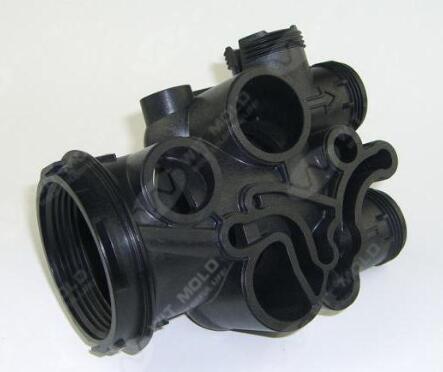
Benefits of Using Unscrewing Molds for Plastic Components
Manufacturing threaded plastic components requires careful control of thread geometry, dimensional accuracy, and part release. Conventional ejection methods may deform or damage threads, particularly when producing rigid plastic parts with deep internal threads.
Unscrewing molds provide a practical solution by rotating the threaded core to release molded parts without forcing them over the thread profile.
WIT Mold manufactures custom unscrewing injection molds for threaded caps, closures, fittings, and industrial plastic components. These molds offer several advantages for manufacturers requiring consistent thread quality and reliable production.
1. Protect Thread Integrity During Demolding
One of the most important benefits of unscrewing molds is their ability to release threaded components without excessive deformation.
In conventional stripping methods, the plastic part must stretch or deform to pass over the mold’s threaded core. This approach may not be suitable for rigid materials or complex thread structures.
Unscrewing molds eliminate the need for forced thread stripping.
Key benefits include:
- Reduced Thread Damage: Controlled rotation helps protect molded thread profiles.
- Better Dimensional Consistency: Threads retain their intended geometry during release.
- Lower Risk of Cracking: Reduced mechanical stress during demolding.
- Improved Functional Reliability: Threads are less likely to be damaged before assembly.
These advantages are particularly valuable for industrial fittings, threaded connectors, and closures requiring reliable engagement.
2. Improve Threaded Component Assembly
Thread accuracy directly affects how plastic components connect with mating parts.
Incorrect thread dimensions or damaged profiles can cause difficult assembly, loose connections, cross-threading, or poor sealing performance.
Unscrewing molds support consistent thread formation and controlled release, helping maintain functional dimensions.
| Product Application | Thread Requirement | Manufacturing Benefit |
|---|---|---|
| Bottle Caps | Consistent opening and closing | Reliable thread engagement |
| Industrial Fittings | Accurate thread profiles | Improved assembly compatibility |
| Cosmetic Closures | Smooth rotational movement | Consistent user experience |
| Threaded Connectors | Controlled fitting dimensions | Reduced assembly interference |
| Plumbing Components | Reliable mechanical connections | Improved joint consistency |
Sealing performance also depends on product design, material properties, and mating components. Mold accuracy alone does not guarantee a leak-free connection.
3. Support Complex Thread Designs
Some plastic products require thread structures that are difficult to release using conventional tooling.
Unscrewing molds provide greater flexibility for manufacturing components with:
- Deep internal threads.
- Multiple thread turns.
- Pronounced thread profiles.
- Rigid materials unsuitable for thread stripping.
- Threads with demanding functional dimensions.
This allows manufacturers to produce certain threaded components directly through injection molding rather than relying on secondary thread-machining operations.
However, not every threaded component requires an unscrewing mechanism. Simpler thread profiles may be manufactured using stripping molds or other release methods.
4. Enable Automated Threaded Part Production
Unscrewing injection molds can integrate the thread-release operation into the injection molding cycle.
Mechanical, hydraulic, or motor-driven mechanisms can coordinate core rotation with mold opening and part ejection.
Compared with manual thread removal or additional machining, automated unscrewing can reduce handling requirements and support repeatable production.
Production advantages include:
- Automated Demolding: Reduces manual intervention during part release.
- Consistent Release Movement: Supports repeatable thread disengagement.
- Reduced Secondary Operations: Suitable designs can produce finished threads directly.
- Production Scalability: Automated mechanisms can support repeated manufacturing cycles.
WIT Mold manufactures customized unscrewing tooling according to thread geometry, plastic material, and production requirements.
5. Reduce Defects and Long-Term Production Costs
Unscrewing molds generally involve higher initial tooling investment because of their rotating cores, transmission components, and mechanical controls.
However, they can provide long-term manufacturing value when conventional thread-release methods cause frequent part damage.
| Cost Factor | Potential Benefit of Unscrewing Molds |
|---|---|
| Damaged Threads | Lower risk of thread deformation during release |
| Manual Handling | Reduced intervention through automated demolding |
| Secondary Machining | Potential elimination of separate thread-cutting operations |
| Rejected Components | Fewer defects associated with forced stripping |
| Production Consistency | Repeatable thread-release operation |
The actual savings depend on production volume, part geometry, cycle time, and tooling maintenance costs.
For high-volume production, the benefits of automated thread release should be compared against the additional mold complexity and maintenance requirements.
6. Maintain Reliable Performance Through Proper Mold Design
The benefits of unscrewing molds depend on the quality of the rotating mechanism and its integration with the injection molding process.
Important engineering considerations include:
- Thread pitch, diameter, and engagement length.
- Core rotation speed and required travel.
- Gear alignment and mechanical clearances.
- Plastic material shrinkage and cooling behavior.
- Ejection timing and part positioning.
At WIT Mold, our quality control process covers mold design, machining, assembly, trial molding, and inspection. Proper mechanism fitting and trial verification are important for reliable unscrewing mold operation.
Frequently Asked Questions
Are unscrewing molds better than stripping molds?
Unscrewing molds are generally preferable for rigid materials, deep threads, and geometries that cannot tolerate stripping deformation. Stripping molds may be more economical for suitable shallow threads and flexible materials.
Can unscrewing molds reduce manufacturing defects?
Yes. They can reduce defects associated with forced thread stripping, including damaged thread profiles and cracking. Other defects still require suitable mold design and processing control.
Are unscrewing molds suitable for mass production?
Yes. Automated unscrewing molds can support repeated production of threaded components. The appropriate cavity count, drive mechanism, and cycle time depend on the project requirements.
Custom Unscrewing Mold Manufacturing With WIT Mold
WIT Mold provides custom unscrewing mold design and manufacturing for threaded plastic components requiring accurate thread formation, controlled demolding, and reliable production.
With injection mold manufacturing experience since 2011, we develop tooling based on customer drawings, thread specifications, material requirements, and production quantities.
Contact WIT Mold to submit your threaded component drawings and request a custom unscrewing mold quotation.